Everything included. No surprises.

7-day free trial · No credit card needed · Cancel anytime

Free Trial
$0
7 days, all features
  • ✓ All 30+ features
  • ✓ No credit card
  • ✓ Full access
Pro
$15.99/mo
All core features
  • ✓ All 30+ features
  • ✓ Pricing calculators
  • ✓ Orders & invoices
Pro+
$22/mo
Pro + WhiskMail
  • ✓ Everything in Pro
  • ✓ WhiskMail email marketing
  • ✓ Automations & AI assist

Author: marciadex

  • Expired Ingredients Are Ruining Your Reputation — Here’s How to Stay Ahead of It

    Expired Ingredients Are Ruining Your Reputation — Here’s How to Stay Ahead of It

    Baker checking ingredient labels and dates in a home kitchen

    Here’s something nobody talks about enough in the cottage baking world:

    Expired ingredients are a real problem.

    Not just for your bottom line — but for your customers’ safety and your reputation.

    A batch of cookies made with rancid butter. A cake filled with cream cheese that was two weeks past its date. These aren’t hypotheticals. They happen — usually to bakers who are busy, overwhelmed, and just trying to keep up with orders.

    Why Expiration Date Management Matters More Than You Think

    When you’re running a home bakery or cottage bakery, you’re often buying in bulk to save money. That means larger quantities of perishable ingredients sitting in your kitchen for longer periods of time.

    Without a system to track expiration dates, you’re relying on your memory. And when you’re juggling five orders, three flavors, and a custom design request — your memory is not enough.

    For cottage bakers operating under cottage food laws in New Jersey, Texas, Florida, California, and across the country, serving a product made with expired ingredients — even accidentally — can make a customer sick. And in the cottage food industry, that kind of mistake can end your business overnight.

    This Isn’t Just About Food Safety. It’s About Money.

    Every expired ingredient you throw away is money you already spent.

    When you track expiration dates properly, you use older stock first. You plan your orders around what needs to be used up. You stop throwing bags of flour and tubs of frosting in the trash.

    It’s called FIFO — first in, first out. Professional bakeries live by it. And with the right tool, home bakers can too.

    Here’s what happens without it:

    – You buy a fresh bag of flour and push the older one to the back

    – Six weeks later you find it — expired

    – You toss it and buy another bag

    – That’s three bags paid for, one bag used

    Multiply that across a full pantry of ingredients and you’re looking at a serious money leak every single month.

    How BatterSuite Keeps You on Top of It

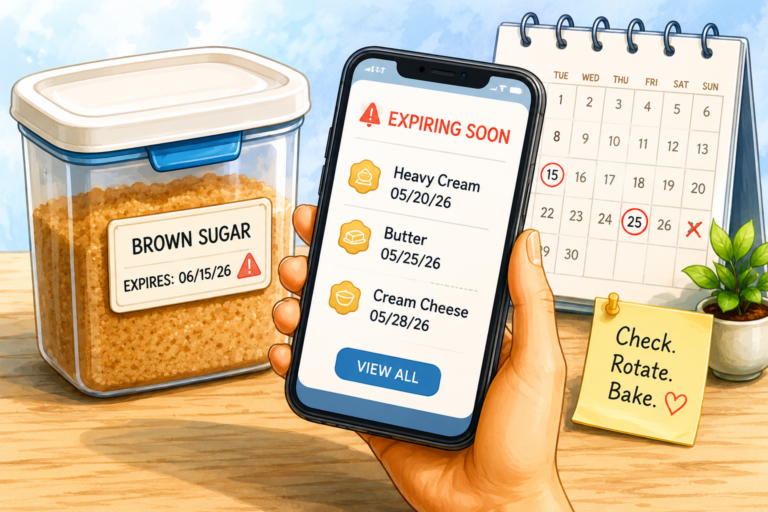
    BatterSuite lets you log expiration dates for your ingredients when you add them to your inventory.

    Here’s what that looks like in practice:

    – Add an ingredient, enter the expiration date

    – BatterSuite flags anything expiring soon

    – You prioritize those ingredients in your next bake

    – Nothing gets forgotten in the back of a shelf

    For home bakers and cottage bakers juggling multiple product lines and order calendars, this kind of visibility is the difference between running a tight operation and constantly playing catch-up.

    You stop discovering losses after the fact. You stop throwing money in the trash. And you stop worrying about whether that cream cheese you grabbed is still good.

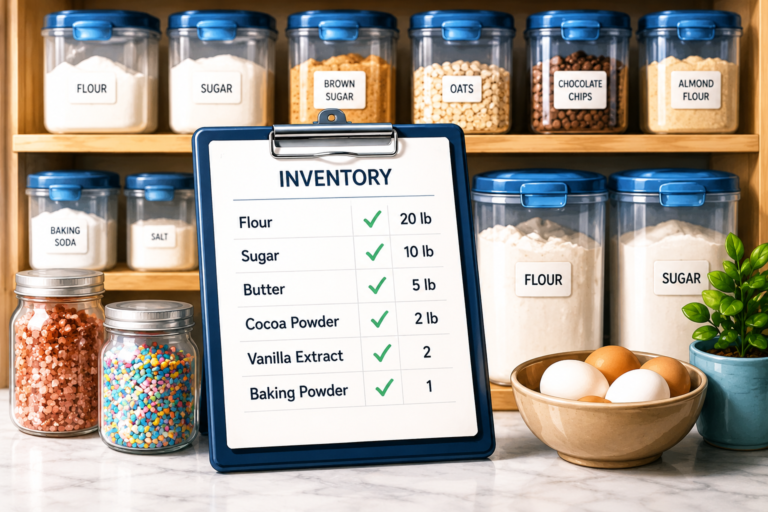
    Organized home baker pantry with labeled and dated ingredients

    Stay Fresh. Stay Safe. Stay in Business.

    The bakers who build lasting reputations aren’t just talented — they’re consistent. Their products always taste right because their ingredients are always fresh.

    BatterSuite’s expiration date management is one more thing that works in the background so you don’t have to think about it. Less waste. Less risk. More confidence in every order you send out the door.

    Get Early Access to BatterSuite →*

    *Questions about food safety or ingredient management for your cottage bakery? Drop them in the comments.*

  • Your Ingredient Inventory Is a Mess — And It’s Costing You More Than You Think

    Your Ingredient Inventory Is a Mess — And It’s Costing You More Than You Think

    Baker organizing ingredients in kitchen pantry

    You’re halfway through a Saturday baking session and you reach for the vanilla extract.

    It’s empty.

    Sound familiar?

    Ingredient inventory is one of the most overlooked parts of running a home bakery or cottage bakery. It’s not glamorous. It’s not fun. But when it goes wrong, everything else goes wrong with it.

    The True Cost of Poor Inventory Management

    Running out of an ingredient mid-bake means last-minute grocery runs. It means paying full retail price instead of buying in bulk when it’s on sale. It means wasted time driving instead of baking.

    Overbuying is just as bad. You end up with four bags of almond flour when you only needed one — and half of it expires before you use it.

    Either way, money is walking out the door.

    For home bakers and cottage bakers operating across the country — in New Jersey, New York, Texas, Florida, and beyond — this kind of waste adds up fast. When you’re running a cottage food business on tight margins, there’s no room to bleed money on supplies you didn’t need or couldn’t use.

    What Good Ingredient Tracking Actually Looks Like

    Good inventory management means you always know:

    – What you have on hand right now

    – What you’re running low on

    – What you need to order before your next round of bakes

    It sounds simple. But without a system, it almost never happens.

    Most bakers track this in their head. Or on a sticky note. Or not at all.

    And then they take on an order they can’t fulfill without a panic trip to three different stores.

    How BatterSuite Tracks It For You

    BatterSuite keeps a running inventory of your ingredients right inside the app.

    Here’s how it works:

    – Add your ingredients and current stock levels

    – When you build a recipe, BatterSuite tracks what gets used

    – When stock runs low, it flags it — before you’re mid-bake and out of butter

    – You always know where you stand before you commit to an order

    No sticky notes. No guessing. No emergency grocery runs.

    For cottage bakers and home bakers juggling multiple orders at once, this is a real game changer. You can see at a glance whether you have enough on hand to take on that last-minute request — before you say yes and regret it.

    Home baker reviewing ingredient stock in organized pantry

    Less Waste. Less Stress. More Money in Your Pocket.

    The bakers who run smooth, profitable operations aren’t necessarily buying more or working harder. They’re working smarter — because they know what they have before they need it.

    BatterSuite’s ingredient inventory tracking is built for exactly that. One place. Always up to date. No spreadsheets required.

    Get Early Access to BatterSuite →*

    *Questions about managing your home bakery inventory? Drop them in the comments.*

  • Stop Guessing What Your Baked Goods Actually Cost — Here’s How to Fix It

    Stop Guessing What Your Baked Goods Actually Cost — Here’s How to Fix It

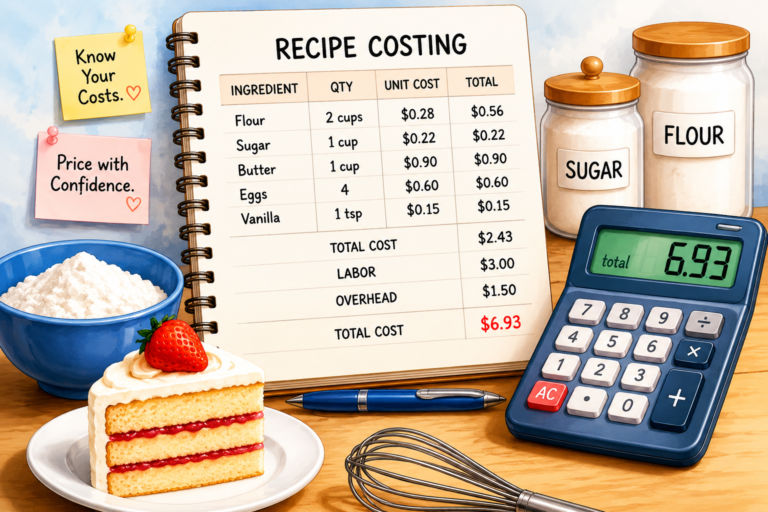
    Baker calculating costs at kitchen table with notebook and ingredients nearby

    If you’ve ever finished a big cake order and thought, “I don’t think I made any money on that” — you’re not alone.

    Most home bakers and cottage bakers have no idea what their recipes actually cost. Not really. They guess. They round down. They forget to count the eggs they grabbed from their own fridge.

    And then they wonder why the money never adds up.

    The problem isn’t your pricing. It’s your costing.

    What Is Recipe Costing?

    Recipe costing is the process of calculating exactly how much it costs you to make one batch, one cake, one dozen cookies. Every ingredient. Every fraction of a cup.

    When you don’t know your real cost, you can’t set a real price. And when you can’t set a real price, you’re guessing at your own profit margin.

    That’s not a business. That’s a hobby with extra stress.

    For cottage bakers and home bakers operating under cottage food laws — in New Jersey, Texas, Florida, California, and across the country — tight margins make this even more critical. One underpriced order doesn’t just cut into your profit. It can mean you worked for hours and actually lost money.

    What Most Bakers Miss

    Ingredients are only part of the cost. Here’s what usually gets left out:

    Electricity — running your oven for two hours has a real cost

    Packaging — boxes, labels, tissue paper, ribbon

    Your time — shopping, baking, decorating, delivering

    Equipment wear — your mixer isn’t lasting forever

    Gas or delivery costs — if you drop off orders

    When you add it all up, that $1.50 cupcake that costs $0.50 in ingredients might actually cost $1.80 to produce. You’re not breaking even. You’re subsidizing your customer’s party.

    How BatterSuite Solves This

    BatterSuite has a built-in recipe costing system designed specifically for home bakers and cottage bakers.

    Here’s how it works:

    1. Enter your ingredients and what you paid for them

    2. BatterSuite calculates the cost per unit — per ounce, per gram, per cup

    3. Build your recipe inside the app

    4. BatterSuite tells you exactly what that recipe costs to make

    No spreadsheets. No calculator. No guessing.

    You also factor in overhead — electricity, packaging, your time — because those things cost money too, even if they don’t come in a bag from the grocery store.

    When ingredient prices change (hello, egg prices), you update the cost in one place. Every recipe that uses that ingredient recalculates automatically. You’ll see immediately which products are now unprofitable and by how much.

    Overhead view of a home baker's workspace with baked goods and pricing notes

    Know Your Numbers. Price With Confidence.

    The bakers who build sustainable home businesses aren’t necessarily the most talented. They’re the ones who took their numbers seriously and stopped guessing.

    BatterSuite gives you those numbers — automatically, every time.

    Get Early Access to BatterSuite →*

    *Have a costing question we didn’t cover? Drop it in the comments.*

  • What Is the Best Software for Home Bakers?

    What Is the Best Software for Home Bakers?

    If you’re running a home bakery, you’ve probably tried to manage everything with a mix of spreadsheets, notes apps, and DMs. It works — until it doesn’t.

    At some point, every home baker hits the same wall: too many orders to track manually, prices that aren’t actually profitable, invoices that never get sent, and customers falling through the cracks. That’s when you start asking: is there software built for this?

    The short answer is yes. Here’s what to look for — and what actually works.

    What Home Bakers Actually Need From Software

    Most business software is built for restaurants, retail stores, or generic service businesses. None of that fits a home baker taking custom orders, managing dietary restrictions, pricing by the dozen, and operating under cottage food laws.

    The software that works for home bakers needs to handle:

    • Recipe costing — calculating exact ingredient costs per item, not just guessing
    • Pricing — factoring in labor, overhead, and profit margin automatically
    • Order management — tracking custom orders with due dates, deposits, and special instructions
    • Customer records — remembering order history, birthdays, and preferences
    • Invoicing — sending professional invoices with online payment links
    • Tax tracking — knowing your revenue and expenses without hiring an accountant

    Most tools handle one or two of these. Very few handle all of them. And almost none are designed with the home baker’s workflow in mind.

    The Options Home Bakers Usually Try First

    Spreadsheets

    Free, flexible, and completely overwhelming once you have more than 10 active orders. Spreadsheets don’t send invoices, remind you of due dates, or calculate your profit margin automatically. They also break when you need them most.

    Generic invoicing apps (Wave, FreshBooks, QuickBooks)

    Good for invoicing, but they have no concept of recipes, ingredient costing, or custom cake orders. You’d still need separate tools for everything else.

    Cake-specific order forms (Cake Boss, Cupcake app)

    Some niche tools exist for order management, but most are outdated, lack mobile support, or don’t include the business management features a growing home bakery needs.

    Etsy or WooCommerce storefronts

    Great for selling products, but not built for the back-end management of a custom order business — no recipe costing, no CRM, no production scheduling.

    What Makes BatterSuite Different

    BatterSuite was built by a home baker, for home bakers. It’s the only platform that combines every tool a cottage food business needs into one place:

    Recipe Builder and Ingredient Costing

    Enter your recipes once. BatterSuite calculates the exact cost per item — down to the gram — every time ingredient prices change.

    Pricing Calculator

    Set your labor rate, overhead percentage, and profit margin. BatterSuite tells you exactly what to charge. No more guessing, no more undercharging.

    Order and Quote Management

    Send professional quotes, convert them to orders, track deposits, due dates, and special instructions for every job.

    Customer CRM

    Every customer’s order history, birthdays, allergies, and preferences — all in one place. Never forget a repeat customer again.

    Invoices with Online Payment

    Send invoices with a direct pay link. Accept payments via Stripe, PayPal, or Square without leaving BatterSuite.

    Public Storefront

    Give customers a beautiful page to browse your menu, check availability, and place orders — without needing a separate website.

    WhiskMail Email Marketing

    Send newsletters, seasonal promotions, and birthday reminders directly from BatterSuite. Built-in, no third-party tool needed.

    Reports and Tax Summary

    See your revenue, expenses, and profit at a glance. Get quarterly tax estimates automatically calculated so tax season isn’t a surprise.

    Production Scheduling

    Plan your baking calendar, batch orders by due date, and generate ingredient pull sheets automatically.

    How Much Does BatterSuite Cost?

    BatterSuite costs $15.99/month or $175/year (equivalent to 2 months free). Both plans include all 30+ features — there are no feature-gated tiers or add-ons.

    A 30-day free trial is available with no credit card required. You can also try the live demo without creating an account.

    Is BatterSuite Right for You?

    BatterSuite is the right fit if you:

    • Take custom orders for cakes, cookies, or other baked goods
    • Struggle to price your products profitably
    • Manage customers and orders manually (DMs, texts, notes)
    • Need to track revenue for tax purposes
    • Want a professional storefront without building a separate website
    • Are operating as a cottage food business or licensed home bakery

    If you’re just starting out and taking one or two orders a month, a simple spreadsheet might be enough for now. But once your business starts growing, having the right systems in place from the beginning saves a lot of painful reorganizing later.

    The Bottom Line

    The best software for home bakers is one that was actually built for home bakers — not adapted from a restaurant POS or a generic invoicing tool.

    BatterSuite is the only all-in-one platform designed specifically for cottage food businesses and home bakeries. It handles everything from recipe costing to customer management to tax reporting, so you can spend less time on admin and more time baking.

    Start your free 30-day trial at battersuite.com — no credit card required.

    BatterSuite is built by SweetTube Academy, an education and software platform for home bakers founded by Marcia Dexter — a licensed home baker from Beachwood, NJ.

  • How to Manage Bakery Orders Without Losing Your Mind

    How to Manage Bakery Orders Without Losing Your Mind

    You have four orders due this weekend, two more coming in via DM, and you’re pretty sure someone’s deposit didn’t clear. The group chat notification just went off again. And you still haven’t sent that invoice from last Tuesday.

    This is the reality for most growing home bakers — and it’s completely fixable.

    Here’s how to build a system that keeps your orders organized, your customers happy, and your stress level manageable.

    The Real Problem: You’ve Outgrown Your System

    When you first started taking orders, a notes app or a basic spreadsheet was fine. Two or three orders a month? Easy.

    But as your business grows, informal systems start to break:
    – Orders slip through the cracks
    – You forget about deposits that were never paid
    – Due dates sneak up on you
    – Customers ask for updates and you have to go digging through texts to answer
    – You overbooking yourself because you don’t have a real calendar

    None of this is your fault — it’s a systems problem, not a you problem.

    The Core Elements of a Bakery Order System

    A functional order management system for a home baker has six parts.

    1. A Single Place for Every Order

    Stop taking orders across DMs, texts, emails, and paper. Every order needs to live in one place — with all the details attached: flavor, size, design notes, customer name, due date, pickup or delivery, special dietary needs.

    If you have to go hunting for order details, your system is broken.

    1. Quote Before You Commit

    Before confirming any order, send a written quote. This protects you (no surprise “I thought it was $40” conversations) and gives the customer a clear record of what they ordered.

    A quote should include:
    – Order description and flavor
    – Size and servings
    – Price
    – Deposit required
    – Pickup or delivery date and time
    – Any special instructions

    1. Track Deposits Separately

    Deposits prevent no-shows and late cancellations — but only if you actually track whether they’ve been paid.

    Keep a clear record of: deposit amount, whether it’s been received, and payment method. Don’t start an order until the deposit is confirmed.

    1. Build a Production Calendar

    Look at your upcoming orders and work backwards from each due date. When do you need to bake? When do you decorate? If an order needs fondant flowers, those might need 2 to 3 days to dry.

    A visual calendar of upcoming orders prevents you from accidentally double-booking your weekend or starting a batch too late.

    1. Send Invoices — Actually Send Them

    Many home bakers collect payment at pickup because they never got around to invoicing. This leads to awkward cash conversations and customers who forget to bring the full amount.

    Send a final invoice before the order is due. Include a way to pay online. Make it easy for the customer to pay in advance.

    1. Follow Up After Delivery

    A quick follow-up message after a customer picks up their order does two things: it catches any issues early, and it opens the door to a review or referral. Most bakers skip this entirely.

    A Day-in-the-Life With a Good Order System

    With the right system in place, your day looks different:

    • Morning: Check your dashboard — 3 orders this week, all details visible, deposits confirmed
    • A customer DMs about a birthday cake — you send a quote in 2 minutes from a template
    • They accept and pay the deposit — it’s logged automatically
    • The order appears on your production calendar with the bake date already calculated
    • The night before pickup, the invoice is sent — they pay online before they arrive
    • After pickup, a follow-up message goes out

    No chaos. No lost orders. No 11pm “wait, when was that cake due?” moments.

    Tools Bakers Use (and What Works Best)

    Spreadsheets: A spreadsheet can handle basic order tracking, but it doesn’t send invoices, manage a calendar, or remind you about deposits. It’s a starting point, not a solution.

    Google Forms + Sheets: A step up — you can capture order info via a form. But you still need separate tools for invoicing, payments, and scheduling.

    Generic CRMs (HubSpot, Dubsado): Built for service businesses, not bakers. No recipe integration, no baking-specific fields, often expensive and overcomplicated.

    BatterSuite: Built specifically for home bakers. Quotes, orders, deposits, invoices, a production calendar, and customer records all in one place — with pricing calculated automatically from your recipes.

    How BatterSuite Handles Order Management

    In BatterSuite, every order goes through the same flow:

    1. Quote — create a professional quote in minutes, send it to the customer
    2. Order — customer accepts, quote converts to a confirmed order
    3. Deposit — log the deposit, mark it received when payment comes in
    4. Production — order appears on your baking calendar with due date
    5. Invoice — send with one click, customer pays via Stripe, PayPal, or Square
    6. Customer record — all details saved automatically for future orders

    Every order is tracked in one dashboard. No spreadsheets, no DM archaeology.

    Start your free 30-day trial at battersuite.com — no credit card required.

    The Bottom Line

    Managing bakery orders doesn’t have to feel chaotic. With the right system — one central place for orders, a quote-first workflow, deposit tracking, a production calendar, and proper invoicing — you can grow your business without growing your stress.

    The system doesn’t have to be complicated. It just has to be consistent.

    BatterSuite is built by SweetTube Academy, an education and software platform for home bakers founded by Marcia Dexter — a licensed home baker from Beachwood, NJ.

  • Do Home Bakers Need a CRM? Yes — Here’s Why

    Do Home Bakers Need a CRM? Yes — Here’s Why

    When most home bakers hear “CRM,” they picture something corporate — a tool for sales teams tracking leads through a pipeline. Not exactly a fit for a one-person bakery operating out of a home kitchen.

    But a CRM is just a system for managing your customer relationships. And for a home baker whose business runs on repeat orders and word-of-mouth referrals, good customer management might be the highest-leverage thing you can add to your operation.

    What a CRM Actually Is (in Plain Language)

    CRM stands for Customer Relationship Management. In practice, it’s a place to store information about your customers — their contact details, their order history, their preferences — so that you can serve them better over time.

    For a home baker, that looks like:
    – Knowing that Sarah always orders a gluten-free option
    – Remembering that Mike’s kids are allergic to nuts
    – Seeing that a customer hasn’t ordered in 8 months and might need a reminder
    – Having the order history ready when someone calls to re-order “that cake from last Easter”

    None of this requires enterprise software. It requires a habit of capturing and organizing customer information.

    The Cost of Not Tracking Your Customers

    Most home bakers keep customer info scattered across texts, DMs, and memory. This has real costs.

    Missed repeat orders. Your best customers want to order again — but life gets busy. A quick birthday reminder email can convert into a $150 order you otherwise would have missed.

    Awkward conversations. “Remind me what you ordered last time?” is fine once. It signals to a loyal customer that they’re not remembered.

    Dietary mistakes. Forgetting that a customer has a nut allergy isn’t just a bad experience — it’s a liability.

    Lost referral opportunities. A follow-up message after a delivery costs 30 seconds and generates referrals. Most bakers never send it.

    What to Track for Every Customer

    You don’t need to collect a lot. The basics are enough to make a real difference:

    • Name and contact info — email, phone, how they prefer to communicate
    • Order history — what they ordered, when, how much they paid
    • Dietary needs and allergies — gluten-free, dairy-free, nut allergies, vegan
    • Flavor and design preferences — they always go for lemon, they love minimalist designs
    • Important dates — birthday, kids’ birthdays, anniversary — any recurring event that triggers a cake
    • How they found you — referral, Instagram, farmers market

    With this information on hand, you can personalize every interaction. That personalization is your competitive advantage over grocery store bakeries.

    The Repeat Customer Math

    Acquiring a new customer — through Instagram, a market, a referral — takes real effort. A repeat customer requires almost none.

    If a loyal customer orders 3 to 4 times a year at an average of $80 per order, that’s $240 to $320 per customer per year. You don’t need hundreds of customers to build a sustainable business. You need a manageable number of loyal ones.

    A CRM helps you cultivate those relationships systematically — not just when you happen to remember.

    Simple Ways to Use Customer Data

    Birthday reminders: A week before a customer’s birthday (or their kids’ birthdays), send a personal note. “Hey, Emma’s birthday is coming up — want to order her usual strawberry cake?” This converts at a remarkably high rate.

    Seasonal outreach: Before Valentine’s Day, Mother’s Day, or the holidays, reach out to past customers who’ve ordered in previous years. They already trust you. They’re likely to order again.

    Win-back campaigns: If a customer hasn’t ordered in 6 or more months, a simple “we miss you” message with a small offer can reactivate them.

    Post-delivery follow-ups: A quick “hope they loved it!” message after every delivery opens the door to reviews and referrals.

    None of this is complicated. The hard part is consistency — which is where having a system helps.

    CRM Options for Home Bakers

    A spreadsheet: You can track customer info in a Google Sheet. It works — but you have to build and maintain it yourself, and it won’t send reminders or connect to your orders.

    Generic CRMs (HubSpot Free, Airtable): More powerful, but not built for bakers. You’ll spend a lot of time adapting them to your workflow.

    BatterSuite: BatterSuite’s customer CRM is built specifically for home bakers. Every order is automatically attached to the customer record. Allergies, preferences, and order history are all in one place. WhiskMail (BatterSuite’s built-in email tool) lets you send birthday reminders and seasonal campaigns without a separate email platform.

    How BatterSuite’s Customer CRM Works

    When you create an order in BatterSuite, the customer record is created automatically. Going forward:

    • Every order is logged to that customer’s profile
    • Allergy and dietary notes are flagged on every order
    • You can see their full order history in one view
    • Birthday and anniversary reminders can be set and triggered through WhiskMail
    • You can filter customers by last order date to find who’s overdue for a follow-up

    It’s not a complicated enterprise CRM. It’s exactly what a home baker needs — nothing more.

    Try BatterSuite free for 30 days at battersuite.com.

    The Bottom Line

    You don’t need a CRM because your business is big. You need one because your business runs on relationships — and relationships are hard to manage from memory.

    The home bakers who build loyal, repeat customer bases aren’t necessarily the most talented bakers. They’re the ones who remember the details, send the follow-up, and make every customer feel like a regular.

    A good customer management system makes that possible — at any scale.

    BatterSuite is built by SweetTube Academy, an education and software platform for home bakers founded by Marcia Dexter — a licensed home baker from Beachwood, NJ.

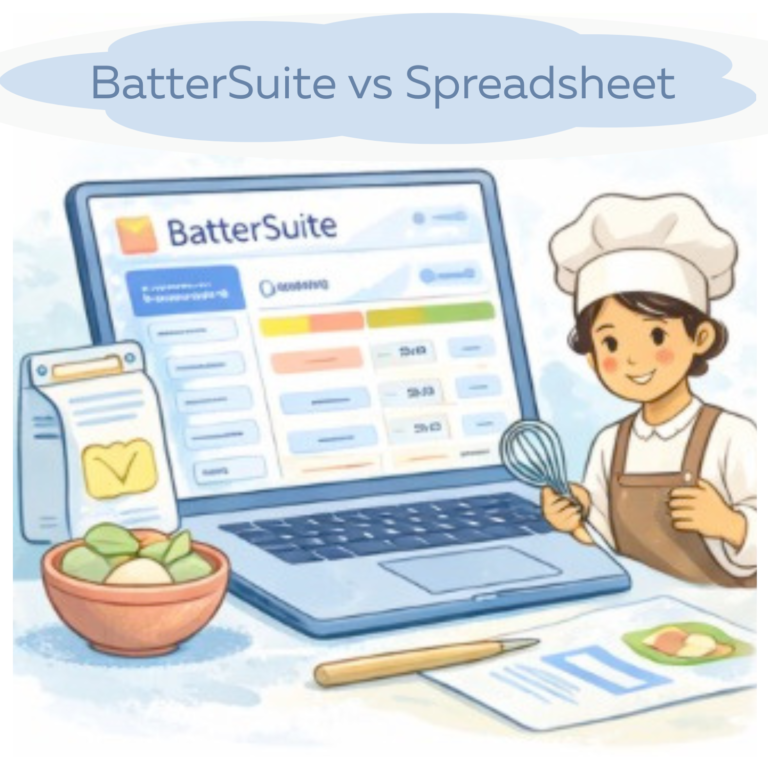
  • BatterSuite vs. Spreadsheets: Why Bakers Are Making the Switch

    BatterSuite vs. Spreadsheets: Why Bakers Are Making the Switch

    Every home baker starts with spreadsheets. They’re free, familiar, and flexible. You can make them do almost anything if you’re willing to put in the time.

    So why are so many bakers switching to dedicated bakery management software?

    This is an honest comparison — not a sales pitch disguised as one. Spreadsheets are genuinely useful. But there are specific points where they stop being enough, and it’s worth knowing where those lines are.

    What Spreadsheets Do Well

    Spreadsheets are legitimately good for:

    • Simple order logging — a list of upcoming orders with dates, customer names, and prices
    • Basic recipe costing — if you set it up carefully and update it manually
    • Revenue tracking — recording what you’ve earned each month
    • Expense tracking — logging ingredient purchases and business costs

    If you’re taking 2 to 5 orders a month and you’re comfortable with Excel or Google Sheets, a spreadsheet can get the job done. Many bakers run small operations this way indefinitely.

    Where Spreadsheets Start to Break Down

    The limitations show up when your business grows — or when you need spreadsheet functions that don’t exist.

    Spreadsheets don’t send invoices.
    You can calculate a total in a spreadsheet. You cannot send that total to a customer with a payment link attached. You need a separate tool for invoicing, which means managing data in two places.

    Spreadsheets don’t send quotes.
    A spreadsheet can help you calculate a price — but sending a professional, branded quote to a customer requires copying that information somewhere else. Most bakers end up quoting via DM, which is informal, hard to track, and offers no paper trail.

    Spreadsheets don’t update ingredient costs automatically.
    If butter prices go up, you have to find every recipe that uses butter and update the cost manually. Miss one, and your pricing is wrong. BatterSuite updates every recipe the moment you change an ingredient price.

    Spreadsheets don’t have a calendar.
    A list of orders sorted by date is not the same as a production calendar. Spreadsheets can’t show you when you’re overbooked, flag orders that need to start today, or generate a weekly baking schedule.

    Spreadsheets don’t track deposits.
    You can add a column for “deposit received” — but it won’t remind you to follow up on unpaid deposits, and it won’t reconcile with your payment records.

    Spreadsheets don’t store customer profiles.
    Every order in a spreadsheet is a row. Customers are just data in a cell. There’s no customer record that shows order history, allergies, birthdays, and preferences across all of someone’s orders.

    Spreadsheets don’t accept payments.
    You still need Venmo, PayPal, or Square. Your payment records are in one app, your orders are in a spreadsheet, and reconciling the two is a manual job.

    Spreadsheets can’t send email.
    No birthday reminders. No seasonal promotions. No follow-up after delivery. You need a separate email marketing tool — another platform to manage, pay for, and keep in sync.

    The Hidden Cost of Spreadsheets

    Spreadsheets feel free because the software is free. But the real cost is time and accuracy.

    Setup time: A properly built bakery spreadsheet — with recipe costing, order tracking, customer data, and expense logging — takes many hours to build correctly.

    Maintenance time: Every ingredient price change, new recipe, or order update has to be entered manually. Errors accumulate.

    Mental overhead: When your systems live across 3 to 4 tools (spreadsheet, invoicing app, payment app, email marketing), every task requires switching between them and manually keeping data consistent.

    For a hobby baker, this overhead is manageable. For a baker running a real business, it’s time that could be spent baking, marketing, or resting.

    A Side-by-Side Comparison

    Feature | Spreadsheet | BatterSuite
    Recipe costing | Manual setup required | Built-in, updates automatically
    Order tracking | Yes (basic) | Yes (full order lifecycle)
    Quote creation | No | Yes — professional, branded
    Invoice sending | No | Yes — with online payment link
    Payment acceptance | No | Yes (Stripe, PayPal, Square)
    Deposit tracking | Manual | Built-in
    Production calendar | No | Yes
    Customer CRM | No | Yes — full profile with history
    Email marketing | No | Yes (WhiskMail, built-in)
    Public storefront | No | Yes
    Pricing calculator | Manual setup | Automatic
    Ingredient cost updates | Manual | Automatic
    Mobile-friendly | Depends | Yes
    Cost | Free | $15.99/month or $175/year

    Who Should Stick With Spreadsheets

    If you’re just starting out and taking a small number of orders, a spreadsheet is fine. Don’t fix what isn’t broken.

    Stick with spreadsheets if:
    – You’re taking fewer than 5 orders a month
    – You have no plans to grow
    – You enjoy building and maintaining your own systems
    – Budget is a primary concern

    Who Should Switch to BatterSuite

    Consider making the switch if:
    – You’re spending significant time on admin tasks (quoting, invoicing, tracking)
    – You’ve had orders fall through the cracks
    – You’re undercharging because pricing takes too long to calculate manually
    – You want to accept online payments without cobbling together multiple apps
    – You want to send professional quotes and invoices (not just DMs)
    – You’re growing and need your systems to grow with you

    The $15.99 per month cost pays for itself if it saves you even one hour of admin time — or prevents you from undercharging a single order.

    The Transition Isn’t Hard

    One concern bakers have about switching: “I already have everything in my spreadsheet. Starting over sounds awful.”

    BatterSuite doesn’t require you to import years of history. Most bakers start by entering their current recipes and upcoming orders. Customer records build naturally as you take new orders. Within a few weeks, you have a complete system without a painful migration.

    Try BatterSuite free for 30 days at battersuite.com — no credit card required. Keep your spreadsheet as a backup if you want — but we don’t think you’ll need it.

    The Bottom Line

    Spreadsheets are a starting point, not a destination. For a growing home bakery, they create more work than they save — because they weren’t built for the specific workflow of a custom order business.

    BatterSuite was. That’s the difference.

    BatterSuite is built by SweetTube Academy, an education and software platform for home bakers founded by Marcia Dexter — a licensed home baker from Beachwood, NJ.

  • How to Create a Pricing Strategy for a Cottage Food Business

    How to Create a Pricing Strategy for a Cottage Food Business

    Pricing is the thing most cottage food bakers get wrong — and it’s not because they’re bad at math. It’s because they’ve never been given a clear framework for how pricing actually works.

    Most bakers start by looking at what others charge and picking a number in that range. The problem: you have no idea whether those bakers are profitable either.

    Here’s how to build a pricing strategy from the ground up — one that covers your costs, reflects your value, and leaves room for your business to grow.

    Why Pricing Is Harder for Cottage Food Businesses

    Cottage food businesses operate in a specific context that makes pricing more complex than a typical food business:

    • No storefront means you can’t rely on foot traffic or impulse buys — every sale is intentional and often higher-stakes
    • Custom orders mean every job is different, so you can’t just set one price and be done
    • Legal constraints (no wholesale, often no online sales, depending on your state) limit revenue channels
    • You’re the only employee, which means your time is both your biggest cost and your most limited resource

    A pricing strategy for a cottage food business has to account for all of this.

    The Three Pricing Methods (and Which Actually Works)

    Cost-Plus Pricing

    Calculate your total cost (ingredients + labor + overhead) and add a profit margin on top. This is the most reliable method because it guarantees you never sell below cost.

    Best for: most custom orders, any product where costs are predictable.

    Market-Based Pricing

    Research what competitors charge and price within that range. This ensures you’re not dramatically out of step with customer expectations.

    Best for: checking your cost-plus price against reality. Use it as a sanity check, not a starting point.

    Value-Based Pricing

    Price based on what the product is worth to the customer — not just what it cost you to make. A wedding cake for 200 guests isn’t just dollars worth of ingredients and labor. It’s worth the stress relief of having a reliable baker, the aesthetic of a custom design, the certainty on the most important day of someone’s life.

    Best for: high-stakes, high-personalization orders (weddings, milestone events).

    The right approach: Start with cost-plus. Check against market rates. Apply value-based thinking for premium orders.

    Building Your Cost-Plus Price: The Full Breakdown

    Ingredient Cost

    Calculate the per-item ingredient cost for every product you sell. Don’t estimate — actually work through the math.

    A dozen chocolate chip cookies might use flour, sugar, butter, eggs, chocolate chips, vanilla, salt, baking soda, plus packaging: bag, label, tissue paper. Add it all up. This is your ingredient cost.

    Labor Cost

    Set an hourly rate for yourself. Factor in all active time: prep, baking, decorating, packaging, cleaning. Don’t include time you’re just waiting for something to bake (unless you can’t do anything else during that time).

    A starting rate of $15 per hour is minimum. Skilled decorators should be at $20 to $30 per hour. You are not a volunteer.

    Overhead

    Monthly fixed costs divided by number of orders per month. Include:
    – Utilities (electricity, gas for your oven)
    – Equipment depreciation
    – Business insurance
    – Packaging supplies not included in per-item cost
    – Business software
    – Licensing fees
    – Farmers market fees, if applicable (prorate by expected sales)

    Profit Margin

    This is not your pay — it’s the business’s margin. Reinvest it in equipment, savings, marketing, or growth. Target 15 to 25 percent for a healthy cottage food business.

    Formula: (Ingredients + Labor + Overhead) divided by (1 minus Profit %) = Minimum Selling Price

    Example:
    – Ingredients: $28
    – Labor: $90
    – Overhead: $8
    – Total cost: $126
    – At 20% profit margin: $126 divided by 0.80 = $157.50 minimum price

    Common Pricing Mistakes Cottage Food Bakers Make

    Charging only for ingredients. A $12 dozen of cookies that took 2 hours to make means you paid yourself $0 and lost money on overhead. This is the most common mistake.

    Using grocery store prices as a benchmark. Grocery store baked goods are mass-produced. You are not. Your custom, handmade product should never be priced against factory output.

    Giving discounts too freely. A 20% discount on a $60 order costs you $12. That might be more than your profit margin. Discounting without knowing your numbers is how bakers work hard and earn nothing.

    Not raising prices when costs go up. Ingredient costs fluctuate. If butter prices spike and you don’t adjust, your margin shrinks. Review your pricing at least quarterly.

    Charging less for people you know. Friends and family want to support your business. Charging them properly is not rude — it’s sustainable. A friends and family discount of 10 to 15 percent is reasonable. Working for free is not.

    Setting Prices by Product Category

    Cookies (per dozen)
    – Simple drop cookies: $20 to $30
    – Decorated sugar cookies: $36 to $60 and up

    Cakes (by tier and complexity)
    – Sheet cake (serves 12 to 15): $45 to $75
    – Round 2-layer cake: $55 to $90
    – Tiered custom cake: $120 to $300 and up

    Cupcakes (per dozen)
    – Simple frosting: $28 to $40
    – Custom piping and toppers: $42 to $60 and up

    These ranges exist because ingredient costs, local market rates, and your labor rate all vary. Use them as a sanity check after running your own numbers — not as a substitute for calculating your actual costs.

    Handling the “That’s Too Expensive” Response

    Some customers will push back on your prices. Here’s how to think about it:

    A customer who says you’re too expensive is telling you something about their budget, not about your value. The right response is not to lower your price — it’s to offer a smaller or simpler option that fits their budget, or to politely acknowledge that you might not be the right fit.

    Bakers who discount on demand train customers to always negotiate. Hold your pricing.

    How BatterSuite Simplifies Your Pricing

    BatterSuite’s Pricing Calculator is built for this exact workflow. Enter your recipes once — with ingredient costs — and the tool calculates your ingredient cost per item automatically. Set your labor rate, overhead, and profit margin, and BatterSuite gives you your minimum price in seconds.

    When ingredient prices change, update the cost once and every recipe recalculates. No spreadsheet maintenance, no manual math.

    Try BatterSuite free for 30 days at battersuite.com.

    Your Pricing Strategy, Summarized

    1. Calculate your true cost: ingredients + labor + overhead
    2. Add a 15 to 25 percent profit margin
    3. Check against market rates in your area
    4. Apply value-based pricing for premium, high-stakes orders
    5. Review prices quarterly as ingredient costs change
    6. Hold your prices — discounting erodes your business

    Pricing isn’t just math. It’s a statement about the value of your work. Price accordingly.

    BatterSuite is built by SweetTube Academy, an education and software platform for home bakers founded by Marcia Dexter — a licensed home baker from Beachwood, NJ.

  • How to Calculate the Cost of a Custom Cake (Step by Step)

    How to Calculate the Cost of a Custom Cake (Step by Step)

    If you’ve ever finished a custom cake and wondered whether you actually made any money on it, you’re not alone. Most home bakers underprice — not because they don’t work hard, but because they don’t have a reliable system for calculating true cost.

    Here’s the complete method, step by step.

    Why Most Bakers Get Cake Pricing Wrong

    The most common mistake is calculating only ingredient costs and then adding a rough markup. This leaves out labor (often the biggest expense), overhead, and any profit margin at all.

    A cake that costs $18 in ingredients and sells for $45 isn’t profitable if it took you 4 hours to make.

    To price correctly, you need to account for four things:
    1. Ingredient cost
    2. Labor cost
    3. Overhead cost
    4. Profit margin

    Step 1: Calculate Ingredient Cost

    Go through your recipe and list every ingredient used, including the exact amount. Then calculate the cost of that amount based on what you paid for the package.

    Example:
    – Flour: 2 cups from a 5 lb bag that cost $4.50 — 5 lb bag is about 18 cups — $4.50 divided by 18 = $0.25 per cup — 2 cups = $0.50
    – Butter: 1 cup from a $5.00 lb (2 cups) — $5.00 divided by 2 = $2.50 per cup — 1 cup = $2.50
    – Eggs: 3 eggs from a $4.50 dozen — $4.50 divided by 12 = $0.375 each — 3 eggs = $1.13

    Add up every ingredient — including salt, vanilla, food coloring, and decorations. Don’t skip the small ones. They add up.

    Ingredient total for a 2-tier custom cake: approximately $22 to $35 depending on design and flavors.

    Also add packaging cost: box, ribbon, cake board, any inserts. These are real costs.

    Step 2: Calculate Labor Cost

    Decide what your time is worth per hour. A reasonable starting point is $15 to $25 per hour for a skilled home baker.

    Track how long the cake actually takes — including:
    – Baking and cooling time (active monitoring)
    – Filling, stacking, and crumb coating
    – Final decorating
    – Cleanup
    – Any customer communication or design consultations

    Example: 5 hours total at $18 per hour = $90 in labor.

    Labor is usually the largest cost in a custom cake. If you’re not including it, you’re working for free.

    Step 3: Add Overhead

    Overhead covers the costs of running your baking operation that aren’t tied to a specific order:
    – Electricity and gas for baking
    – Kitchen equipment depreciation (stand mixer, pans, tools)
    – Insurance
    – Packaging supplies you keep on hand
    – Business software and tools
    – Any licensing or cottage food permit fees

    A simple approach: estimate your monthly overhead costs and divide by the number of orders you take per month.

    Example: $120 per month overhead divided by 15 orders = $8 per order.

    Step 4: Add Profit Margin

    Many bakers skip this step entirely — but profit isn’t the same as labor pay. Profit is what lets your business grow: buying new equipment, taking a slow month, or eventually paying yourself more.

    A standard target for small food businesses is 15 to 30 percent profit margin.

    Formula:
    (Ingredients + Labor + Overhead) divided by (1 minus Profit %) = Minimum Price

    Example:
    – Ingredients: $28
    – Labor: $90
    – Overhead: $8
    – Total cost: $126
    – At 20% profit margin: $126 divided by 0.80 = $157.50 minimum price

    Step 5: Check Against the Market

    Once you have your cost-based price, compare it to what other custom cake bakers in your area charge. If your price is in range — great. If it’s higher, consider where you can reduce cost or whether you can justify the premium with your quality or service.

    Never price below your cost-based minimum just to match competitors. That’s how bakers burn out.

    The Problem With Doing This Manually

    This process works — but doing it by hand for every order is exhausting. Ingredient prices change. Recipes scale. You forget to update your spreadsheet.

    Most home bakers either skip steps (and undercharge) or spend 30 minutes or more pricing every single order.

    How BatterSuite Makes This Automatic

    BatterSuite’s Recipe Builder calculates the exact ingredient cost for every recipe — down to the gram — and updates automatically when ingredient prices change.

    The Pricing Calculator then factors in your labor rate, overhead, and target profit margin to give you a final price to quote your customer.

    What used to take 30 minutes takes about 30 seconds.

    Try BatterSuite free for 30 days at battersuite.com — no credit card required.

    Quick Reference: Custom Cake Cost Formula

    Ingredient Cost
    + Labor Cost (hours x hourly rate)
    + Overhead (monthly costs divided by orders per month)
    = Total Cost

    Total Cost divided by (1 minus Profit %) = Minimum Selling Price

    Run this calculation for every order — or let BatterSuite do it for you.

    BatterSuite is built by SweetTube Academy, an education and software platform for home bakers founded by Marcia Dexter — a licensed home baker from Beachwood, NJ.

  • Why Home Bakers Are Losing Money — Real Questions from Real Bakers (and What to Do About It)

    Why Home Bakers Are Losing Money — Real Questions from Real Bakers (and What to Do About It)

    You poured hours into that order. You sourced the best ingredients, piped every rosette perfectly, and delivered on time. Then you sat down to figure out what you actually made — and the number was embarrassing.

    If that sounds familiar, you’re not alone. Home bakers across Reddit, CakeCentral, and cottage food Facebook groups ask versions of the same question every single week: “Why does it feel like I’m working for free?”

    We collected some of the most common questions and concerns real bakers are asking right now — and answered them honestly.

    “I charge $1.50 per cupcake but my ingredients alone cost $0.50. Am I undercharging?”

    This exact question came up in a CakeCentral forum thread where a baker noticed competitors charging $1.25–$1.50 per cupcake and wondered how that was even sustainable. Her instinct was right to be suspicious.

    Here’s the problem: $0.50 in ingredients per cupcake sounds manageable — until you add everything else.

    • Electricity to run your oven for 2 hours
    • Packaging (boxes, tissue paper, labels)
    • Your time to shop, bake, decorate, and deliver
    • A portion of your mixer that’s slowly wearing out
    • The gas to drive to the customer

    When you add all of that up, that $1.50 cupcake might actually cost you $1.80 to produce. You’re not breaking even — you’re subsidizing your customer’s party.

    What BatterSuite does: The recipe cost calculator automatically tracks every ingredient down to the gram. When you build a recipe, you enter your bulk purchase price (say, a 5 lb bag of flour for $4.99) and BatterSuite calculates the exact cost per cup, per tablespoon — whatever unit your recipe uses. No spreadsheet math required.

    “A customer told me my prices were ‘way out of their price range.’ Should I lower them?”

    This is one of the most emotionally loaded questions in the home baker community. The short answer: probably not.

    Bakers who lower prices to match the objection almost always regret it. Here’s why: the customers who push hardest on price are usually not your customers. The right customer for handmade, high-quality cottage food is not comparison shopping against grocery store sheet cake.

    What that customer comment is actually telling you: your marketing may not be reaching the right audience yet.

    The deeper issue bakers miss: Many home bakers don’t actually know their real cost. They guess at it. So when a customer pushes back on price, there’s a moment of self-doubt — “Maybe I am charging too much?” — when the reality is they have no way to confirm either way.

    What BatterSuite does: When you know your exact cost of goods, your labor rate, and your overhead allocation, you can stand confidently behind your price. BatterSuite builds your price from the ground up: ingredients + labor + overhead + profit margin. You’ll know exactly what you need to charge to hit your goals — and you can explain it to yourself (and occasionally a pushy customer).

    “How do I even figure out what my hourly rate should be?”

    This comes up constantly in r/Baking, r/sidehustle, and cottage food Facebook groups. Bakers spend 6 hours on a custom cake, charge $80, and then realize they made $13/hour before expenses.

    There’s no single right answer for hourly rate — it depends on your local market, experience level, and business goals. But here’s a starting framework:

    1. Start with your target income. What do you need to earn per month from baking?
    2. Estimate your capacity. How many hours per week can you realistically bake and run your business?
    3. Divide. That’s your minimum effective hourly rate.
    4. Add overhead. Rent (if applicable), insurance, supplies, marketing.

    If your math says you need to charge $35/hour and the market in your area only supports $20/hour — that’s important information. It means you either need to find higher-margin products, reduce your costs, or be realistic about what this side hustle can earn.

    What BatterSuite does: The pricing calculator lets you set your labor rate and automatically factors it into every quote. Change your rate once — every recipe and order quote updates. You can also see at a glance which products are actually profitable versus which ones are eating your time for little return.

    “Egg prices went through the roof. How do I adjust without losing customers?”

    This is a very current pain point. Egg prices spiked sharply in early 2025 due to widespread avian flu outbreaks — hitting over $5/dozen in many parts of the country — and home bakers who hadn’t updated their pricing got caught absorbing those costs.

    The discomfort bakers feel about raising prices is real. But here’s the business reality: if your costs go up and your prices stay the same, your margin disappears.

    A few ways bakers handle ingredient price increases:

    • Be transparent with regulars. A short note like “ingredient costs have increased, so I’ve adjusted pricing” is usually well received by loyal customers.
    • Build in a small buffer. Price slightly above current costs so you’re not immediately underwater when an ingredient spikes.
    • Raise prices proactively, not reactively. Waiting until you’re losing money to raise prices means the increase feels bigger and more urgent to both you and your customers.

    What BatterSuite does: When ingredient prices change, you update the cost in one place — your ingredient library. Every recipe that uses eggs automatically recalculates. You’ll see immediately which products are now unprofitable and by how much. No hunting through spreadsheets.

    “I finished a huge holiday order and barely broke even. What did I miss?”

    This is the post-mortem almost every home baker writes at some point. You take a big order, pour everything into it, and the final number is a disappointment.

    What usually gets missed:

    • Time to shop — driving to 3 stores to find the right sprinkles is unbillable unless you build it in
    • Packaging costs — boxes, ribbon, tissue, labels add up fast, especially for large orders
    • Electricity and oven wear — running your oven for 8 hours across a big order has a real cost
    • Custom design time — the hour you spent sketching out a custom cake design before you even baked anything
    • Order management — emailing back and forth with the client, revising the design, following up on payment

    Most bakers track ingredients. Almost none track the full picture.

    What BatterSuite does: The overhead allocation feature lets you define your fixed and variable overhead costs — utilities, packaging averages, insurance, supplies — and BatterSuite distributes that overhead across your orders automatically. You stop discovering losses after the fact.

    “I feel guilty charging what my bakes are actually worth.”

    This one doesn’t get posted publicly as often, but it shows up in private Facebook groups and in DMs between bakers all the time. There’s a real psychological barrier around charging full price for something you love doing.

    Some reframe that’s helped other bakers:

    • Your skill took years to develop. You’re not charging for “just a cake” — you’re charging for everything you learned to make that cake.
    • Undercharging isn’t humility — it devalues the craft for every baker in your community.
    • If you burn out because you’re making nothing, the thing you love becomes a source of stress.

    The bakers who thrive long-term are the ones who learn to separate their emotional attachment to the work from the financial reality of running a business.

    “Is there an easier way to manage all of this? I’m just one person.”

    Yes — and that’s exactly why BatterSuite was built.

    Most home bakers are running their business out of a mix of Notes apps, Google Sheets, DMs, and mental math. It works — until it doesn’t. Until an order gets lost. Until you can’t remember what you charged someone last year. Until tax season and you have no idea what your actual revenue was.

    BatterSuite brings everything into one place:

    • Recipe cost calculator — build your recipes, track every ingredient cost, see your cost of goods at a glance
    • Pricing tool — set your labor rate and profit margin, get a price that actually works
    • Order management — track orders from inquiry to delivery, never lose a detail
    • Client records — every customer, every order, every conversation, organized
    • Gift certificates — sell and redeem gift certificates built right in
    • Loyalty program — reward your repeat customers automatically

    At $22.99/month (or $199/year — that’s less than $17/month), it’s built specifically for the scale of a cottage food or home bakery operation. Not a bloated restaurant POS. Not a generic invoicing tool. Something made for bakers, by people who understand the business.

    The Bottom Line

    The bakers who are building sustainable home businesses aren’t necessarily the most talented. They’re the ones who took pricing seriously, learned their real costs, and stopped guessing.

    The questions above aren’t unique to any one baker — they’re the questions the whole community is asking. And the answers all point in the same direction: you need real numbers to make real decisions.

    BatterSuite gives you those numbers.

    (insert CTA link)

    Have a pricing question we didn’t cover? Drop it in the comments — we read every one.